Showing posts with label china. Show all posts

Thursday, September 18, 2014

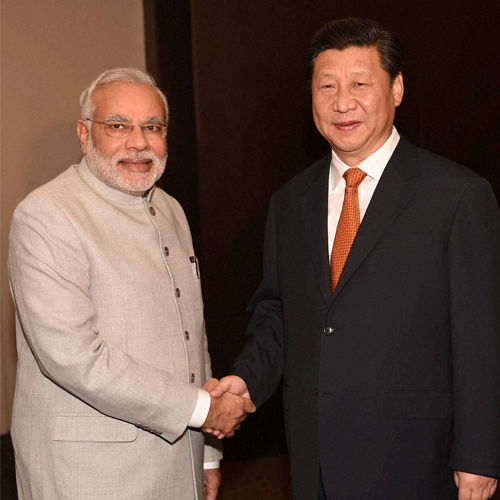
Pull back your troops who have entered Ladakh Modi tells Xi


The past caught up with the efforts of Prime Minister Narendra Modi and President Xi Jinping to elevate bilateral ties, leading the PM to protest against China's bid to escalate tensions in Ladakh.

It was the festering border row which Modi sought to address first in his meeting with Xi on Thursday as he told him that peace and tranquillity along the borders was imperative for mutual trust and for realizing the full potential of Sino-Indian relations.

"This is an important understanding, which should be strictly observed," Modi said as he raised "serious concerns" over what India calls serial transgressions by the Chinese.

Pitching for a quick clarification of the Line of Actual Control (LAC), Modi told Xi that China had to restore the status quo that existed before September 10 in Ladakh this year. Foreign minister Sushma Swaraj also raised the issue with her counterpart Wang Yi.

Modi, in fact, set the tone on Wednesday evening itself when, just after the public display of bonhomie, he raised the latest Chinese transgressions at Chumar in Ladakh in an after-dinner "pow-wow" with Xi.

The Chinese president came back with a response on Thursday when he told Modi that he had "noted'' India's concerns and that the incidents in Ladakh may be a fallout of the non-demarcated border.

Sources said Modi took up the border issue strongly because the understanding in the government was that the incidents at Chumar could not have taken place without the concurrence of the top Chinese leadership.

In fact, even as vigorous diplomacy continued, the Army had ensured enough presence in the region to outnumber the Chinese troops. Sources said more Indian troops were ready to move into the region where civilians formed a human wall to prevent the Chinese from moving into what India claims to be its territory.

Xi, however, said such incidents should not be allowed to impact bilateral relations. "There may be some incidents as the area is not clearly demarcated," Xi said in a media statement, but added that both sides were capable of not just effectively managing the border but also of resolving the border dispute "at an early date''.

The NDA government's first bilateral engagement at the highest level with China yielded as many as 16 agreements and MoU, including one expected to ensure investments worth $20 billion into India from China over the next five years.

Modi also raised India's concerns over China's visa policy for residents of Arunachal Pradesh and J&K and also over trans-border rivers, saying their resolution would take mutual trust to a new level.

India wants the Ladakh standoff to end immediately, with Modi telling Xi that a clarification of LAC and settlement of the dispute "would greatly contribute to our efforts to maintain peace and tranquillity". He requested Xi to look at resuming the stalled process of LAC clarification. Modi had an extended interaction with Xi which included 75 minutes of restricted meeting, 50 minutes of delegation talks and a 15-minute one-on-one.

Apart from the assurance from Xi that the border dispute could be resolved soon, an important takeaway for India was the declaration, for the first time, of support from the Chinese president for India's full membership of Shanghai Cooperation Organization (SCO), a central Asia security grouping of six countries dominated by Russia and China.

India currently has observer status at SCO which is expected to play a crucial role in Afghanistan once the Nato forces depart from there. Xi added in the same breath though that India too would support China's role in Saarc. Indian officials later clarified though that this wasn't a condition for Chinese support for India's SCO membership.

India and China, said Indian officials, also decided to hold the first round of maritime cooperation dialogue within this year to exchange views on security, including anti-piracy, freedom of navigation and cooperation between maritime agencies of both countries. Progress was also made in promoting cooperation under the framework of the BCIM (Bangladesh, China, India, Myanmar) Economic Corridor. "Located at the crossroads of Asia, India believes that reconnecting Asia is important for its collective prosperity," Modi said.

The two countries also decided to have annual visits at the level of head of state/government with Xi inviting Modi to visit China early next year.

-TOI

Tuesday, September 16, 2014

Sabarmati Riverfront Preparations for Visit of Narendra Modi and Xi Jinping

Ahmedabad Sabarmati Riverfront Preparations for Visit of Narendra Modi and Xi Jinping


Monday, September 15, 2014

China President Xi Jinpings India visit strengthen ties Narendra Modi

There is a deliberative attempt at innovation in every decision prime minister Narendra Modi takes and after this it may become a norm. Chinese president Xi Jinping, who starts his three-day India visit on September 17 from Ahmedabad, is the first foreign dignitary to start off from outside Delhi. It is the norm that state visits start off in the national capital. However, from now on, foreign heads of state and government would be encouraged to start by exploring other parts of the country apart from the Capital.

The PM will be in Ahmedabad to receive the Chinese head of state. Another first would be that there will be official talks during Xi's day-long stay in the Guajarat capital, Modi's home state. The ministry of external affairs spokesman Syed Akbaruddin said there would be signing of agreements, which is again a first. He was not in a position to disclose anything about the nature of agreements to be signed, but he assured that those signed in Ahmedabad will pertain to that region. There will be other agreements that Modi and Xi will sign in Delhi after officials talks, at the meeting between the two leaders along with aides and later at delegation level.

There has been much preparation on the part of India for the visit, especially through national security adviser Ajit Doval's visit to Beijing last week, where he called on Xi and met ministers and officials to discuss the visit. Akbaruddin said Doval conveyed to the Chinese government that India sees "the visit as an important landmark". It is only the third Chinese presidential visit. The earlier ones were that of Jian Zemin in 1996 and Hu Jintao in 2006. The MEA spokesperson said that the "new government was engaged in intensive global engagement" and Xi's visit is being seen as part of this new drive.

There have been brisk exchange of visits between the two countries ever since Modi took over as prime minister in May. Chinese prime minister Li Keqiang was the first foreign leader to have telephoned Modi and congratulated him after the swearing-in. Modi had met Xi on the sidelines of the BRICS summit in Brazil in July, and it was followed by vice president Hamid Ansari's visit to China. Minister for external affairs Sushma Swaraj had met her Chinese counterpart Wang Yi twice, first in June in Nw Delhi and again on the sidelines of the Asean Regional Forum in Myanmar's capital Naypyidaw in August.

The MEA spokesman and joint secretary (east) in the ministry Pradeep Rawat did not reveal any breakthrough agreements on the economic front nor on the crucial issue of border talks. To repeated queries about Chinese incursions in the north-east, Akbaruddin said that incursions will be handled on the ground by the "brave sentinels" and made it out that it will not in any way impact on the Modi-Xi talks because these are a different thing altogether.

Monday, August 18, 2014

China Liberation Army intrudes 25 km deep in Ladakh

Defence minister Arun Jaitley being received by Lt Gen K.J. Singh, Western Army Commander. (Photo: PTI) Chinese troops are reported to have entered 25 to 30 km deep into Indian territory in the Burtse area in Ladakh on Sunday and were still sitting on the ground on Monday with flags reading “This is Chinese territory, go back” in their hands. However, Army sources in New Delhi said no such incident had taken place but added that transgressions usually take place by Chinese troops due to differences between both countries in their respective perception of the Line of Actual Control (LAC).

But news agency reports from Leh on Monday said a patrol of Indian troops noticed the People’s Liberation Army (PLA) personnel on Sunday while moving from their base towards the higher “new patrol base” post in Burtse area of North Ladakh in Jammu and Kashmir. The area is at an altitude of 17,000 feet. These reports cited sources as having said that the troops, after walking barely 1.5 km from their base, spotted the Chinese personnel in Indian territory 25 to 30 km from the perceived Line of Actual Control (LAC).

Adhering to newly-drafted standard operating procedures, the Indian troops apparently returned back to their base but went on a patrol again to the “new patrol base” post in the early hours of Monday. However, the team found no change in the situation as it noticed the PLA personnel still sitting on the ground with flags reading “this is Chinese territory, go back” in their hands, the reports said, adding that a quick reaction team had also accompanied the Indian patrol but nothing could be achieved as the Chinese refused to budge from their position. Finally, the Indian troops reportedly returned to their base and informed their senior officers.

Sources in the paramilitary ITBP did not say where the said incident had taken place but added that transgressions do occur. The area where the incident took place is reportedly near the spot where Chinese troops had pitched their tents last year that had led to a tense three-week stand-off.

The Indian border patrol apparently attempted to reach the “new patrol base” from a place known as “Nallah one”, near its base. A satellite image of the area was likely to be taken to ascertain whether the Chinese PLA have pitched in tents like it did last year, the reports from Leh cited sources as saying, adding that there was a possibility of some tents being erected by the Chinese troops to facilitate their movement deep into the Indian territory.

The Burtse area, which is adjacent to Daulat Beg Oldie(DBO), forms part of the huge Depsang plains which India regards as its own territory. However, the Chinese side have been claiming it to be part of their territory as it gives them a tactical edge over the area.

Monday, June 30, 2014

Chinese troops make bids to enter Indian waters in Ladakh

After making incursion bids in Ladakh through land route, Chinese troops have made several attempts to enter Indian waters at Pangong lake nestled in the higher reaches of Ladakh with the latest incident reported on Friday.

According to reports reaching various government agencies here, the Army had a face-off with the Chinese People's Liberation Army (PLA) as recent as June 27 in the lake when their troops tried to enter the Indian waters.

Udhampur-based Northern Command Army spokesman Col S Goswami declined to answer a query from PTI about the latest incursion attempts and instead was asked to "approach PRO (Army)".

However, there was no reply from his side when it was pointed out to him that he was the spokesperson of the Army.

READ ALSO: Chinese troops enter Ladakh every 14 days

The spokesperson of the ministry of external affairs when asked by reporters yesterday about reports of fresh incursions by Chinese troops in Ladakh region merely said Indian soldiers guarding the country's borders will be able to provide an appropriate response should any incident occur on the border.

According to sources privy to the development, Chinese troops were intercepted at the imaginary line that is supposed to be the Line of Actual Control (LAC) in the lake and sent back after the face-off drill during which the army personnel on both sides wave banners claiming it to be their territory.

The incursions have taken place in eastern Ladakh and on the northern bank of Pangong Lake, located 168km from Leh, the sources said.

The Chinese patrols used to come frequently from the northern and southern banks of this lake, whose 45 km stretch is on the Indian side while another 90 km is on the Chinese side.


Pangong is a disputed territory between India and China. (Getty images photo)

However, every attempt was foiled by the Army which has been equipped with new boats.

The high-speed interceptor boats, that were bought from the US, can accommodate nearly 15 soldiers and are equipped with radars, infra-red and GPS systems.

These boats are stated to be as good as the Chinese vessels and are used to conduct reconnaissance and area domination patrols.

The sources said the Chinese patrol boats were backed up by PLA troops from the banks of the lake and the move was apparently to put psychological pressure on the Indian troops who man the area.

The situation along the banks of the lake has always remained volatile with Chinese troops being intercepted by Indian Army patrol several times after the three-week long stand-off in the Depsang plains of Daulat Beg Oldie (DBO) in May last year.

The areas where the face-off frequently occured included the Finger-VIII area, also known as Siri Jap. China has managed to construct a road up to Finger-IV area which also falls under Siri Jap area and is five km deep into the LAC, the sources said.

-TOI

Thursday, October 21, 2010

China sets an example. Asian Games ready for a blast

Subdued torch relay

China sets an example. Asian Games ready for a blast

The organisers limited the Asiad torch relay to within China after what had happened during the 2008 Beijing Olympic Games torch relay, which was marred by protests

Mascots are the pride of Guangzhou

China sets an example. Asian Games ready for a blast

A father and son play next to the mascots for the 2010 Asian Games in Guangzhou. For the residents of Guagnzhou, the rams are becoming an integral part of their daily life.


Test events, a huge success


China sets an example. Asian Games ready for a blast

The test events, conducted at the comprehensive stadium and featuring mock competitions such as qualifications, all-around, floor, etc were a huge success. The comprehensive stadium will play host to sports events as gymnastics, squash and billiard

China set for tourism boom

China sets an example. Asian Games ready for a blast

The Asian Games 2010 is set to herald a tourism boom in China. More than 5 lakh Chinese tourists and nearly 2 lakh overseas tourists are expected at Guangzhou. The city is expecting more than $ 200 million in tourism revenue during the extravaganza.

You are welcome to see anything


China sets an example. Asian Games ready for a blast

Unlike the closely-guarded CWG 2010, the Asiad 2010 has been very open so far. The media was taken on a Games tour last week and one of the highlights was the media centre itself. The big structure comprises Main Press Centre (MPC) and the International Broadcasting Centre (IBC). Trial operation began yesterday and the venue is already the talk of the town.

World-class squash facility

China sets an example. Asian Games ready for a blast

This transparent squash coat is another masterpiece in the upcoming games. It became ready to use more with than 3 months left on the countdown.

Truly a vigorous Guangzhou

China sets an example. Asian Games ready for a blast

The organising committee of Asiad 2010 titled the test campaign as 'Vigorous Guangzhou' and reports suggest these test events started as early as May and concluded last month itself. 'Vigorous Guangzhou' essentially revolved around provincial sporting events and a few national competitions as well.

Rehearsal for the big opening ceremony
underway


China sets an example. Asian Games ready for a blast

Participants hold signboards showing national flags of Lebanon, China, Thailand and Vietnam during a rehearsal of the opening ceremony. The organisers have hinted that the Opening Ceremony venue will be converted to Asian Games Theme Park after the games.


Over 10000 journalists to cover


China sets an example. Asian Games ready for a blast

Over ten thousand journalists have got accreditations done to cover the Asiad 2010. Organisers are saying that a large number are expected from Europe as well despite this being the Asian Games event.

Boost for tier-II cities

China sets an example. Asian Games ready for a blast

The Asian Games is seen as a big boost for second-tier cities in China like Guangzhou and co-hosts Foshan and Dongguan. The event is seen as adding to an already powerful sports infrastructure in the country, which was bolstered by the Beijing Olympics in 2008


The idea behind the mascots


China sets an example. Asian Games ready for a blast

An Asian Games decoration with its mascot is displayed in front of the media village in the Asian Games Town. Five sporty rams, titled 'Le Yangyang' serve as the official mascots of the Games. These five rams namely A Xiang, A He, A Ru, A Yi, and Le Yangyang essentially represent Guangzhou's nickname, 'City of Goats.'

Message of peace and harmony


China sets an example. Asian Games ready for a blast

Chinese paramilitary police will be one of the star attractions in the opening ceremony. They will be instrumental in sending across the message of 'harmony, blessings, success and happiness.'


Torch relay event was a grand affair


China sets an example. Asian Games ready for a blast

The torch relay may have been a subdued affair but the torch relay ceremony was certainly a mega affair. It had the Chinese Premier Hu Jintao greeting the Olympic Council of Asia President Sheikh Ahmad Al-Fahad Al-Sabah.

The idea behind the mascots

China sets an example. Asian Games ready for a blast

An Asian Games decoration with its mascot is displayed in front of the media village in the Asian Games Town. Five sporty rams, titled 'Le Yangyang' serve as the official mascots of the Games. These five rams namely A Xiang, A He, A Ru, A Yi, and Le Yangyang essentially represent Guangzhou's nickname, 'City of Goats.'


Message of peace and harmony


China sets an example. Asian Games ready for a blast

Chinese paramilitary police will be one of the star attractions in the opening ceremony. They will be instrumental in sending across the message of 'harmony, blessings, success and happiness.'

Torch relay event was a grand affair

China sets an example. Asian Games ready for a blast

The torch relay may have been a subdued affair but the torch relay ceremony was certainly a mega affair. It had the Chinese Premier Hu Jintao greeting the Olympic Council of Asia President Sheikh Ahmad Al-Fahad Al-Sabah.

The idea behind the mascot

China sets an example. Asian Games ready for a blast

The mascot was designed on the basis of a story. The story has it that 5 immortals had taken 5 rams to the city of Guangzhou where they prayed to end a situation of famine.

Temple of heaven

China sets an example. Asian Games ready for a blast

Chinese paramilitary police rehearse a flag ceremony before the start of the torch relay for the 2010 Guangzhou Asian Games held at the Temple of Heaven in Beijing

Get ready for mind-blowing opening ceremony

China sets an example. Asian Games ready for a blast

Boats featuring Macau, front, and Mongolia, back, participate in the Asian Games opening rehearsal. The Guangzhou Asian Games' Chief Director, Chen Weiya, has said that the opening ceremony will surprise the world. "You cannot imagine what it will be like," The China Daily quoted Chen, as saying.


Asian Games town ready and roaring


China sets an example. Asian Games ready for a blast

This is the overview of the comprehensive stadium, also known as the Asian Games Town. Just a few days ago, a test event, the 2010 Guangdong Gymnastics Invitation Tournament was held at this venue. Coaches, athletes and spectators were mighty impressed with the venue's top-class facilities and perfect flow of processes

Beijing team at work again

China sets an example. Asian Games ready for a blast

The opening ceremony venue is built near the Central Business District in Guangzhou. The opening ceremony will be handled by the same team, which worked wonders during the opening and closing ceremonies of the Beijing 2008 Olympic Games. So, one can certainly expect a feast.

Wednesday, September 22, 2010

China defies global censure, to build giant N-Plant in Pak

Beijing/Washington: Unfazed by global concerns, Beijing and Islamabad are in talks to set up a new giant one gigawatt atomic power plant in Pakistan, as China is set to expand its investment in nuclear power generation by nearly USD 120 billion over the next decades.

China defies global censure, to build giant N-Plant in Pak

Qiu Jiangang, Vice President of the state run China National Nuclear Corporation (CNNC), which has already helped built Pakistan's main nuclear facility at Chashma in Punjab province, said his company was in talks to set up another giant nuclear plant in Pakistan, 'Wall Street Journal' reported.

"Both sides are in discussion over the CNNC exporting a one gigawatt nuclear plant to Pakistan", he told a meeting in Beijing without giving any details.

Besides the main plant at Chashma, the Chinese company is completing a second reactor there and has contracts to build two more 300 megawatt reactors.

China defies global censure, to build giant N-Plant in Pak

Qiu said, that the first reactor was operating safely and the second one was being tested and expected to start formal operations by the end of the year.

US and India have both expressed concern after China signed a deal in February to build the additional two 300-MW reactors.

Quoting US officials, 'Wall Street Journal' said, such plans required special exemption from the 46-nation Nuclear Suppliers Group (NSG), which China joined in 2004 and which is supposed to regulate the global nuclear trade.

China defies global censure, to build giant N-Plant in Pak

The paper said, Vann H Van Diepen, the US acting assistant secretary of state for nonproliferation had suggested before the House Foreign Affairs Committee in July that the US would vote against such an exemption.

Pakistan is not a signatory to the Nuclear Non-proliferation Treaty and there are concerns by US, Western Nations and India that Pakistan's nuclear material may fall into the hands of Al Qaeda and Taliban who are based close to the Pakistani capital.

China defies global censure, to build giant N-Plant in Pak

The Chinese plans to export yet another nuclear plant to Pakistan comes as Beijing has unveiled plans to invest nearly USD 120 billion to increase nuclear power generation to 70-80 gigawatts by 2020, the 'China Daily' reported today.

The paper said to fund the new spending spree CNNC would list its subsidiary CNNC Nuclear Power Co Ltd.

China has stepped up investment in nuclear power in an effort to slash its carbon emissions and reduce the nations reliability on coal for energy needs.

China defies global censure, to build giant N-Plant in Pak

The daily said China which has emerged as the world's second largest economy was aiming to produce 15 per cent of its power demand from nuclear energy.

China has 11 nuclear power reactors in operation with a capacity of 9.1 gigawatt and the country aims to increase this to 70-80 gigawatts by 2020.

Source: Indian Express