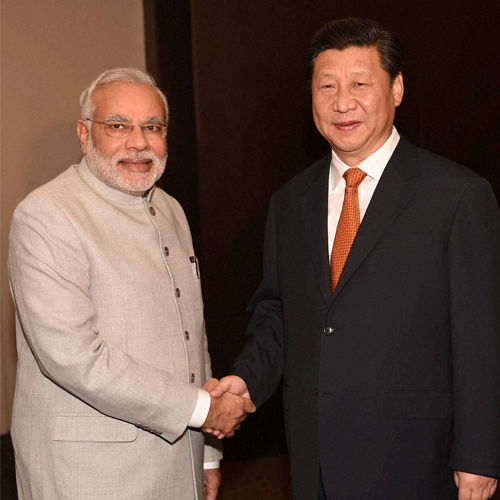
It was the festering border row which Modi sought to address first in his meeting with Xi on Thursday as he told him that peace and tranquillity along the borders was imperative for mutual trust and for realizing the full potential of Sino-Indian relations.
"This is an important understanding, which should be strictly observed," Modi said as he raised "serious concerns" over what India calls serial transgressions by the Chinese.
Pitching for a quick clarification of the Line of Actual Control (LAC), Modi told Xi that China had to restore the status quo that existed before September 10 in Ladakh this year. Foreign minister Sushma Swaraj also raised the issue with her counterpart Wang Yi.
Modi, in fact, set the tone on Wednesday evening itself when, just after the public display of bonhomie, he raised the latest Chinese transgressions at Chumar in Ladakh in an after-dinner "pow-wow" with Xi.
The Chinese president came back with a response on Thursday when he told Modi that he had "noted'' India's concerns and that the incidents in Ladakh may be a fallout of the non-demarcated border.
Sources said Modi took up the border issue strongly because the understanding in the government was that the incidents at Chumar could not have taken place without the concurrence of the top Chinese leadership.
In fact, even as vigorous diplomacy continued, the Army had ensured enough presence in the region to outnumber the Chinese troops. Sources said more Indian troops were ready to move into the region where civilians formed a human wall to prevent the Chinese from moving into what India claims to be its territory.
Xi, however, said such incidents should not be allowed to impact bilateral relations. "There may be some incidents as the area is not clearly demarcated," Xi said in a media statement, but added that both sides were capable of not just effectively managing the border but also of resolving the border dispute "at an early date''.
The NDA government's first bilateral engagement at the highest level with China yielded as many as 16 agreements and MoU, including one expected to ensure investments worth $20 billion into India from China over the next five years.
Modi also raised India's concerns over China's visa policy for residents of Arunachal Pradesh and J&K and also over trans-border rivers, saying their resolution would take mutual trust to a new level.
India wants the Ladakh standoff to end immediately, with Modi telling Xi that a clarification of LAC and settlement of the dispute "would greatly contribute to our efforts to maintain peace and tranquillity". He requested Xi to look at resuming the stalled process of LAC clarification. Modi had an extended interaction with Xi which included 75 minutes of restricted meeting, 50 minutes of delegation talks and a 15-minute one-on-one.
Apart from the assurance from Xi that the border dispute could be resolved soon, an important takeaway for India was the declaration, for the first time, of support from the Chinese president for India's full membership of Shanghai Cooperation Organization (SCO), a central Asia security grouping of six countries dominated by Russia and China.
India currently has observer status at SCO which is expected to play a crucial role in Afghanistan once the Nato forces depart from there. Xi added in the same breath though that India too would support China's role in Saarc. Indian officials later clarified though that this wasn't a condition for Chinese support for India's SCO membership.
India and China, said Indian officials, also decided to hold the first round of maritime cooperation dialogue within this year to exchange views on security, including anti-piracy, freedom of navigation and cooperation between maritime agencies of both countries. Progress was also made in promoting cooperation under the framework of the BCIM (Bangladesh, China, India, Myanmar) Economic Corridor. "Located at the crossroads of Asia, India believes that reconnecting Asia is important for its collective prosperity," Modi said.
The two countries also decided to have annual visits at the level of head of state/government with Xi inviting Modi to visit China early next year.
-TOI