Showing posts with label Wildlife. Show all posts

Tuesday, September 30, 2014

Wildlife Numbers Drop by Half Since last four decades

Earth lost half its wildlife in the past four decades, according to the most comprehensive study on animal populations to date, a far larger decline than has been previously reported.

The latest analysis was done by scientists at the wildlife group WWF, the Zoological Society of London and other organizations. Based on an analysis of thousands of vertebrate species, it concludes that overall animal populations fell by 52% between 1970 and 2010.

The animal population decline was seen everywhere—in rivers, on land and in the seas—and is mainly the result of increased habitat destruction, hunting and fishing, the report said. Climate change is also believed to be a factor, though its consequences are harder to measure.

The previous WWF report analyzing animal populations was published in 2012 and it suggested a decline of 28%. The latest report has 15% more data than the previous one; it is more representative of tropical species; and it includes an improved methodology.

The fastest declines were seen in rivers and other freshwaters systems, where populations have fallen 76% since 1970. By comparison, terrestrial and marine populations each fell 39%.

While biodiversity continues to decline in both temperate and tropical parts of the world, the downward trend is greater in the tropics.

The most dramatic decline was in Latin America, where overall populations of mammals, birds, reptiles, amphibians and fish fell 83%. Asia-Pacific wasn't too far behind, though.

The new findings are calculated using the WWF's "Living Planet Index," a measure of biodiversity based on trends in 10,000 populations of about 3,000 animal species.

The WWF has been compiling its index since 1998. It tracks a large number of animal populations just as a stock market index tracks the value of a group of stocks. The data used in compiling the index are population size, density or a measure of abundance over a length of time.

In a separate section, the WWF report also tries to measure the state of humanity's ability to live in a sustainable way. With the planet's population expected to swell by another 2.4 billion people by 2050, the challenge of providing everyone with food, water and energy will be a difficult one.

The report analyzes sustainability by calculating a global "ecological footprint," which measures the area required to supply the ecological goods and services we use. It concludes that humanity currently needs the regenerative capacity of 1.5 Earths to supply these goods and services each year.

The study says: "This 'overshoot' is possible because—for now—we can cut trees faster than they mature, harvest more fish than the oceans can replenish, or emit more carbon into the atmosphere than the forests and oceans can absorb." Since the 1990s, we have reached that overshoot by the ninth month of each year, it adds.

"It's a very loud wake-up call," said Carter Roberts, president and chief executive officer of WWF US, in an interview. "As we lose natural capital, people lose the ability to feed themselves and to provide for their families—it increases instability exponentially. When that happens, it ceases to be a local problem and becomes a global one."

Thursday, August 7, 2014

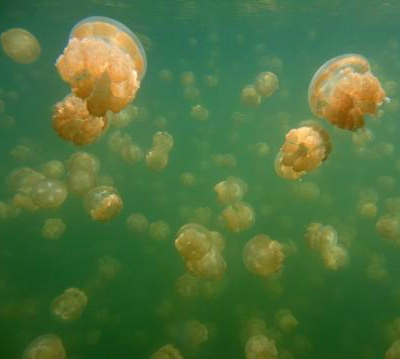
Indias first jellyfish lake discovered

jelly-fishMarine biologists have discovered a jellyfish lake in Gujarat, probably the first such in India.

"This is probably the first jellyfish lake to have been found in India. The concentration and density of jellyfish is very high here. You can even see them from outside during low tide and when the water is clear," wildlife scientist BC Choudhury said.

Led by him, a team of researchers from the Wildlife Trust of India (WTI) have recently stumbled on the jellyfish habitat during a routine field visit to a small town named Armabada in Gujarat.

A couple of WTI marine biologists in snorkeling kits and armed with an underwater camera found that the bottom of the lake, spread over 5-6 hectares, was carpeted with a type of jellyfish known as 'upside down jellyfish'. They are called so because they are found swimming upside down unlike others.

"They position themselves on their bottom side to receive maximum sunlight as they harbour photosynthetic algae called Zooxanthellae, which have a symbiotic relationship with jellyfish similar to corals," explained marine biologist S Goutham.

Another unique feature of the lake is that these jellyfish are present all around the year unlike other places where they are reported to be seasonal. According to experts, the big bloom of jellyfish in the lake might be attributed to low predation.

Jellyfish are found in different parts of coastal India but are seen rarely in lakes. The world renowned jellyfish lake is located on Eil Malk Island in Palau.

Monday, September 6, 2010

This year, 130 leopards poached in India

New Delhi: Watching a leopard amble along a sun-beaten track at dusk is a captivating sight. But now these big cats are in danger in India.

leopards

At least 130 leopards have been poached this year so far, say experts describing the figures as "alarming".

Uttarakhand, Uttar Pradesh and Maharashtra recorded the highest number of leopard deaths, stated the NGO Wildlife Protection Society of India (WPSI).

There have been reports of 240 leopard deaths so far.

leopard
A dead male leopard is carried away by the forest workers at Sukna wildlife rescue centre on the outskirts of Siliguri. The leopard was found dead at a tea garden estate supposedly poisoned by the villagers.

Across the country, 17 leopards were killed in man-animal conflict, 19 died in road accidents, eight were shot dead by the forest department, six died in rescue operations, two were killed by other big cats, while 58 more were found dead, says WPSI.

The rest of the deaths are feared to have been caused by poaching.

Uttarakhand has seen a spurt in leopard deaths. Twenty-nine leopards were poached, four killed in man-animal conflict, including three that were shot dead by the forest department.

leopard

"Thirty-one more leopards were found dead in the state. Some died of natural causes, but others may have died in conflict. We don't have proof," said Tito Joseph of the WPSI. Seven more died in road accidents.

A census in 2007 showed 2,300 leopards in the state.

"We are compiling a report as part of the tiger census this year which will reveal the latest figure of leopards," Paramjit Singh, chief conservator of forests of Uttarakhand, told IANS.

leopard

There is no record of the total number of this agile and stealthy predator in India. They are protected by Schedule 1 of the Wildlife (Protection) Act, the highest protection provided to wild animals.

Fifteen leopards were poached in Maharashtra, 13 in Uttar Pradesh and 12 in Karnataka. Haryana, Rajasthan, Gujarat, Assam and Himachal Pradesh have also seen leopard deaths in man-animal conflicts.

leopard

The buffer areas of wildlife sanctuaries have been the main poaching grounds. Some of these places have seen intense man-animal conflict.

Among big cats, leopards are the most adaptable. They are skilled climbers. Wildlife enthusiasts swear by the exquisite grace with which the animal sways while disappearing into the forests.

Each year, a large number of these endangered animals face unnatural deaths.

leopard
A forest guard carries the body of an 18-month-old leopard at Sukna Wildlife Rescue Centre near Siliguri.

n 2009, some 160 cases of poaching and body parts seizures were recorded.

In 2008, the figure was 157, according to the NGO.

Some members of Haryana's Bawaria tribe are alleged to be involved in organised poaching and operate across a vast area in and around wildlife sanctuaries. They are expert hunters.

"These people (Bawaria poachers) know only how to hunt. They don't have anything else to do. So they kill them for money. It's business," said Singh.

"Poachers from other states also come in two- or three-member groups," he said.

Tito said there are different types of poachers: "One type is organised like the Bawarias.

"Another type is opportunistic - for instance, one who faces the threat of leopard attacks. He will poison the animal and skin it. When he gets a chance he will sell it.

"The third type looks to hunt other animals but will kill a leopard if there is an opportunity."

Source: IANS