Showing posts with label Environment News. Show all posts

Monday, October 13, 2014

Loss of Antarctica Ice Results in Shift of Gravity

Antarctica has lost so much ice that it has caused a shift in Earth's gravity, according to a new study.

The European Space Agency (ESA)'s GOCE satellite has shown that the ice lost from West Antarctica over the last few years has left its signature.

"The loss of ice from west Antarctica between 2009 and 2012 caused a dip in the gravity field over the region," ESA said in a statement.

More than doubling its planned life in orbit, GOCE spent four years measuring Earth's gravity in unprecedented detail.

Scientists are now armed with the most accurate gravity model ever produced.

This is leading to a much better understanding of many facets of our planet - from the boundary between Earth's crust and upper mantle to the density of the upper atmosphere.

The strength of gravity at Earth's surface varies subtly from place to place owing to factors such as the planet's rotation and the position of mountains and ocean trenches.

Changes in the mass of large ice sheets can also cause small local variations in gravity, ESA said.

High-resolution measurements from GOCE over Antarctica between November 2009 and June 2012 were analysed by scientists from the German Geodetic Research Institute, Delft University of Technology, Netherlands, the Jet Propulsion Lab in US and the Technical University of Munich in Germany.

They found that the decrease in the mass of ice during this period was mirrored in GOCE's measurements, even though the mission was not designed to detect changes over time.

GOCE data could be used to help validate satellite altimetry measurements for an even clearer understanding of ice-sheet and sea-level change, ESA said.

ESA's CryoSat satellite, which carries a radar altimeter, has recently shown that since 2009 the rate at which ice is been lost from the West Antarctic Ice Sheet every year has increased by a factor of three.

Between 2011 and 2014, Antarctica as a whole has been shrinking in volume by 125 cubic kilometres a year, the statement said.

Sunday, August 31, 2014

Gujarat coast is breeding area of whale sharks

 
Gujarat coastal region is a breeding area of the whale sharks, the largest species of fish on the planet, a study by Wildlife Trust of India (WTI) says.

"The discovery and reporting of four neonatal (pup) whale sharks has confirmed that the Gujarat coast is indeed a breeding area of whale sharks," according to the study report titled 'Gujarat's Gentle Giant; Conservation of Whale Shark (Rhincodon typus) in Gujarat'.

The report was released here today on the occasion of International Whale Shark Day.

Four whale shark pups have been found off Sutrapada coast in Junagadh district since March last year.

It indicates that the region is not just a whale shark 'aggregating site', but also an important 'pupping ground', the report says.

"All caught pups seemed to be between 1 and 3 months old - the size of an arm - indicating that the fish may be breeding and definitely pupping off the Gujarat coast," says the report.

In March 2013, a young pup was caught in the net of a local fisherman called Mohan Solanki in Sutrapada tehsil in Junagadh district, which was the first time WTI team found evidence that whale sharks may be breeding in the area.

Solanki released the pup before reporting it to WTI.

As per the report, the fishermen themselves started approaching WTI with information on the pups and within one month from the discovery of the first pup, WTI had reports of four pups off Gujarat coastline.

Saturday, August 16, 2014

Tibets glaciers warmest in 2000 years


Tibet's glaciers at their warmest in 2,000 years: Report
The Tibetan plateau, whose glaciers supply water to hundreds of millions of people in Asia, were warmer over the past 50 years than at any stage in the past two millennia, a Chinese newspaper said, citing an academic report.

Temperatures and humidity are likely to continue to rise throughout this century, causing glaciers to retreat and desertification to spread, according to the report published by the Chinese Academy of Sciences' Institute of Tibetan Plateau Research.

"Over the past 50 years, the rate of temperature rise has been double the average global level," it said, according to the report on the website of Science and Technology Daily, a state-run newspaper.

Glacier retreat could disrupt water supply to several of Asia's main rivers that originate from the plateau, including China's Yellow and Yangtze, India's Brahmaputra, and the Mekong and Salween in Southeast Asia.

In May, Chinese scientists said Tibetan glaciers had shrunk 15 percent - around 8,000 square km (3,100 square miles) - over the past 30 years.

The new report said a combination of climate change and human activity on the plateau was likely to cause an increase in floods and landslides there. However, rising temperatures had also improved the local ecosystem, it said.

The scientists urged the government to work to reduce human impact on the region's fragile environment.

But Beijing is building a series of large hydropower projects there, with construction of several mega-dams expected to start by 2020. China has built thousands of dams in the past few decades in a bid to reduce its reliance on imported fossil fuels.

India, too, is planning a number of hydro plants along the Brahmaputra river - more than 100 proposals are under consideration - as the country strives to boost electricity generation.

Tuesday, August 12, 2014

Indian Government is tracing the lost river Saraswati


Govt to trace the lost river Saraswati
Government has launched en effort to unravel the mystery behind the ancient Saraswati river, which found its references in 'vedic' texts.

Though efforts had been made in the past by geologists and scientific community both during British period as well as in independent India, the river remained a mystery so much so that its mention in the ancient texts has invariably been termed as mythological reference.

"There are enough scientific evidences on the presence of the river Saraswati in some parts of the country through which it flowed about five to six thousand years ago...Saraswati is not a myth", said the Union water resources and river development minister Uma Bharti on Tuesday.

Responding to a calling attention motion in Lok Sabha, Bharti said her government was taking up the issue very seriously "to trace the route of the river".

She also informed the lower House that the Central Ground Water Board (CGWB) of her ministry has been directed "to test the water of a well located inside the Allahabad fort" in order to trace the source and route of the river, which is now extinct.

The motion was moved in the House by BJP member Ratan Lal Kataria who wanted the government to set up 'Saraswati Research Institute' for the "revival" of the river. He reminded the House of a promise made by the Prime Minister Narendra Modi who, he claimed, during an election campaign in Kurkshetra vowed to bring the water stream of the river Saraswati on the ground surface.

Stating that a lot of research has been done on the river, particularly in Gujarat, Bharti said there were several rivers named Saraswati which emanated from the Himalayas, including one which mingled with the Triveni in Allahabad, another with Mandakini and the third with Alaknanda river.

She said there was also a river with the same name that passed through Haryana to Rajasthan and Gujarat.

Saturday, August 9, 2014

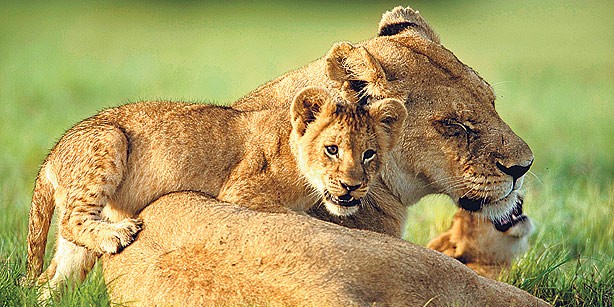
Gujarat lions vanish from UP forest


A month after killing Marius the Giraffe, Danish zoo kills four lions including two cubs to avoid inbreeding. (Photo: Reuters)what actually happened to the three Asiatic lions brought from the Gir forests of Gujarat to Chandraprabha Wildlife Sanctuary in Kashi Wildlife Division is still a mystery. Last counted in 1965, their number was 11.

Interestingly, even the Kashi Wildlife Division officials have no idea or recorded facts about the fate of the big cats brought to the sanctuary when it was opened some five decades back. "There is no record with the department about the disappearance of the lions," said a forest official of Kashi Wildlife division. "It is believed that either they would have fallen prey to the hunters or migrated to nearby jungles of Bihar," said the officer.

"As the Wild Life (Protection) Act, 1972, was not in force at that time, there was no effective control on hunting of wild animals," said forest officer of Kashi Wildlife Division Chandra Shekar Pandey, expressing his worst fear over the fate of the lions. But he added he was not sure about the ordeal the lions faced at that time in the sanctuary as there were no records.

"Lions were released in that region years back and probably all those animals died. We do not have any records maintained of that time, so it's difficult to say what happened of them. Moreover, enforcement was not strong at that time and there must not have been proper planning to release them," said PCCF (wildlife), UP, Rupak De.

The concept of reintroduction for purposes of conservation of Asiatic lions was accepted in 1956 by the Indian Wildlife Board, and the offer of UP government to host a population in the Chakia forests was accepted. In 1956 a lion and two lionesses were captured from Gir and placed in a zoo in Junagadh for nine months before being shifted to Chandraprabha sanctuary in 1957.

Initially, the lions prospered increasing in number to four in 1958, five in 1960, seven in 1962 and 11 in 1965, but after that they disappeared. The forest officials admit that there might have been some shortcoming in monitoring the wild cats.

In other such translocation, eight Gir lions -- four males and four females -- were brought from Gujarat's Junagadh and Hyderabad zoos to UP under animal exchange programme. While three pairs were put up at the Lucknow zoo, one was sent to the Kanpur zoo. Later, one pair was shifted to the Etwah lion safari in April.

Spread in an area of 9,600 hectares of forest, the Chandraprabha Wildlife Sanctuary is located between Chakiya and Naugarh in Chandauli district, the neighbouring district of PM Narendra Modi's parliamentary constituency. The sanctuary was set up in 1957, covering the reserved forest area in Chandraprabha and some parts of Jaimohini Range. The sanctuary has a variety of wild animals, including black buck, chital, sambhar, nilgai, wild boar, porcupine, Indian gazelle, gharial and python.

About 70km from Varanasi Chandraprabha Wildlife Sanctuary are the picturesque Rajdari and Devdari waterfalls. The sanctuary is one of the Protected Areas (PAs) of the National Wildlife Action Plan (2002-2016) that was adopted in 2002 emphasizing the people's participation and their support for wildlife conservation.

Monday, August 4, 2014

Can Ants save Earth from global warming


Can ants save Earth from global warming?
Ants may be cooling the Earth by helping trap carbon dioxide from the environment, a new study has claimed.

A long-term experiment tracking the ants' effects on soil suggests they cooled Earth's climate as their numbers grew.

"Ants are changing the environment," said lead study author Ronald Dorn, from the Arizona State University in Tempe.

Certain ant species "weather" minerals in order to secrete calcium carbonate - better known as limestone. The process traps and removes a tiny bit of carbon dioxide gas from the atmosphere, Dorn said.

This ant limestone factory is a small-scale version of the massive planetary-cooling process that takes place in the oceans, known as carbon sequestration, 'Live Science' reported.

Dorn discovered that ants were powerful weathering agents by tracking the breakdown of basalt sand.

His experiment shows that ants appear to break down the minerals 50 to 300 times faster than sand left undisturbed on bare ground.

According to Dorn, the ants may be scavenging calcium and magnesium from the minerals and using these elements to make limestone.

In the process, the insects may trap carbon dioxide, a greenhouse gas, in the rock, the report said.

The transformation could take place when ants lick sand grains and stick them on the walls of their nests, but Dorn said the process is truly a scientific mystery.

The study was published in the journal Geology.

Sunday, August 3, 2014

Drop in CO2 levels triggered formation of Antarctic ice sheet

http://candidshare.com/share/drop-in-co2-levels-triggered-formation-of-antarctic-ice-sheetA new study suggests that a drop in carbon dioxide (CO2) levels seems to have triggered Antarctic ice sheet formation.Roughly a 40 percent decrease in CO2 occurred prior to and during the rapid formation of a mile-thick ice sheet over the Antarctic approximately 34 million years ago.The long-held, prevailing theory known as "Southern Ocean gateway opening" is not the best explanation for the climate shift that occurred during the Eocene-Oligocene transition when the Earth's polar regions were … Read more at candidshare.com

Monday, July 28, 2014

http://candidshare.com/share/tigers-flourish-and-count-increased-up-india
As per primary estimations for two years from 2011 to 2013, the total number of tigers found in the core area surged from 72 to 80. The final count of tigers in the Dudhwa tiger reserve is expected to be 125, according to officials.In 2010-2011, the total count of tigers as per their census in the Dudhwa tiger reserve was 118.The latest findings have been sent to the Union Ministry of Environment and Forests for screening purpose, according to an official.Once the exact number of tigers present … read more at candidshare.com

Sunday, July 27, 2014

Pesticides killing birds

http://candidshare.com/share/pesticides-killing-birdsA new study has found that pesticides are causing deaths of large number of birds.The insect eating birds are at an increased risk of dying owing to the use of farm insecticides.Swallows are among the 15 insect-eating species of birds which are experiencing decline in population due to the use of farm insecticide called imidacloprid. It is the world's most extensively used farm insecticide.A Dutch research indicates the its effects results in an impact on the food chain to hit birds such as … read more at candidshare.com

Eight more bird species listed as threatened

http://candidshare.com/share/eight-more-bird-species-listed-as-threatenedThis is clear from the fact that the latest International Union for Conservation of Nature (IUCN) Red List (2014) says 173 species in India are now threatened.The latest IUCN list reveals that while earlier, the newly discovered, Bugun Liocichla, a small and colorful bird from the northeast, was vulnerable, now it is critically endangered.That's not all, studies conducted by the Bombay Natural History Society (BNHS)-India, BirdLife International (UK) and other partner organizations indicate … Read more at candidshare.com

Saturday, July 26, 2014

Melting glaciers new lakes in Himachal Pradesh

http://candidshare.com/share/melting-glaciers-new-lakes-in-himachal-pradeshThe officials have issued a warning that a breach could result in flooding the tributaries of Chenab river.

"The lakes (six to seven of them), which were small when I visited earlier, have accumulated much more water now. Some of the lakes are between 1.5 to 2 km long and pose a serious threat," MLA Lahaul and Spiti and vice chairman of National Commission for Scheduled Tribes Ravi Thakur said.

Read More at candidshare.com