Showing posts with label Asiatic Lion. Show all posts

Saturday, August 9, 2014

Gujarat lions vanish from UP forest


A month after killing Marius the Giraffe, Danish zoo kills four lions including two cubs to avoid inbreeding. (Photo: Reuters)what actually happened to the three Asiatic lions brought from the Gir forests of Gujarat to Chandraprabha Wildlife Sanctuary in Kashi Wildlife Division is still a mystery. Last counted in 1965, their number was 11.

Interestingly, even the Kashi Wildlife Division officials have no idea or recorded facts about the fate of the big cats brought to the sanctuary when it was opened some five decades back. "There is no record with the department about the disappearance of the lions," said a forest official of Kashi Wildlife division. "It is believed that either they would have fallen prey to the hunters or migrated to nearby jungles of Bihar," said the officer.

"As the Wild Life (Protection) Act, 1972, was not in force at that time, there was no effective control on hunting of wild animals," said forest officer of Kashi Wildlife Division Chandra Shekar Pandey, expressing his worst fear over the fate of the lions. But he added he was not sure about the ordeal the lions faced at that time in the sanctuary as there were no records.

"Lions were released in that region years back and probably all those animals died. We do not have any records maintained of that time, so it's difficult to say what happened of them. Moreover, enforcement was not strong at that time and there must not have been proper planning to release them," said PCCF (wildlife), UP, Rupak De.

The concept of reintroduction for purposes of conservation of Asiatic lions was accepted in 1956 by the Indian Wildlife Board, and the offer of UP government to host a population in the Chakia forests was accepted. In 1956 a lion and two lionesses were captured from Gir and placed in a zoo in Junagadh for nine months before being shifted to Chandraprabha sanctuary in 1957.

Initially, the lions prospered increasing in number to four in 1958, five in 1960, seven in 1962 and 11 in 1965, but after that they disappeared. The forest officials admit that there might have been some shortcoming in monitoring the wild cats.

In other such translocation, eight Gir lions -- four males and four females -- were brought from Gujarat's Junagadh and Hyderabad zoos to UP under animal exchange programme. While three pairs were put up at the Lucknow zoo, one was sent to the Kanpur zoo. Later, one pair was shifted to the Etwah lion safari in April.

Spread in an area of 9,600 hectares of forest, the Chandraprabha Wildlife Sanctuary is located between Chakiya and Naugarh in Chandauli district, the neighbouring district of PM Narendra Modi's parliamentary constituency. The sanctuary was set up in 1957, covering the reserved forest area in Chandraprabha and some parts of Jaimohini Range. The sanctuary has a variety of wild animals, including black buck, chital, sambhar, nilgai, wild boar, porcupine, Indian gazelle, gharial and python.

About 70km from Varanasi Chandraprabha Wildlife Sanctuary are the picturesque Rajdari and Devdari waterfalls. The sanctuary is one of the Protected Areas (PAs) of the National Wildlife Action Plan (2002-2016) that was adopted in 2002 emphasizing the people's participation and their support for wildlife conservation.

Monday, November 1, 2010

Not really born free!

here was a time when tigers and lions roamed the wild without fear. When the black rhino was the pride of Africa and the elephant was revered in Asia. But incessant poaching, destruction of their natural environment for development and climate change has made these pearls of the wild not just endangered but in many cases ‘critically’ endangered.

Here's a look at some species that may soon be Dinasaured out of the planet.

Not really born free!

Asiatic Lion
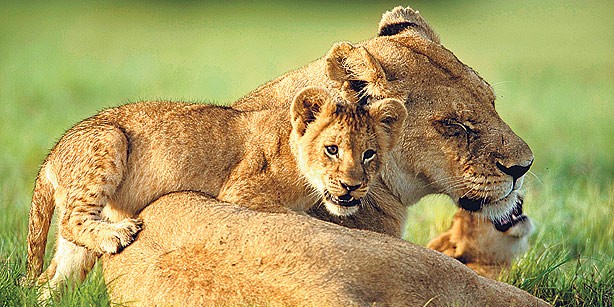
This king of the jungle once ranged from the Mediterranean to the north-eastern parts of the Indian subcontinent, but excessive hunting, water pollution and decline in natural prey reduced their habitat. Today they are found only in the Gir Forest of Gujarat, India. In 2005, 359 Asiatic lions were reportedly sighted in the Gir forest.

Not really born free!

Giant Panda


This cute and cuddly bear, that's been the inspiration not just for movies (Kung-fu Panda) but also many a stuff toys, is native to central-western and south western China. Due to farming, forest clearing, and other development, the Giant Panda has been driven out of the lowland areas where it once lived. Today China has 239 Giant Pandas in captivity and another 27 living outside the country. It also estimated that around 1,590 pandas are currently living in the wild.

Not really born free!

Asian Elephant
Hunted for it ivory tusks, the majestic Asian elephant is considered an endangered species with only about 50,000 left in the wild. Found primarily in Bangladesh, India, Sri Lanka, Indochina and parts of Nepal and Indonesia, Vietnam and Thailand, the animal is widely domesticated and has been used in forestry in South and Southeast Asia for centuries as well as in ceremonial purposes.

Not really born free!

Bactrian Camel
Native to the northeastern Asia, this two-humped camel is in the critically endangered species list. Although an estimated 1.4 million Bactrian camels live in domestication, only 950 remain in the wild today and the number is decreasing.

Not really born free!

Black Rhinoceros
About 3,600 Black Rhinos exist in the world today. Although referred to as 'black', the animal is actually grey, white or brown in appearance. The Rhino has been poached to near extinction for its horns, which are believed to have medicinal properties (and in some folklore magical properties). In 1990, the two horns from a single black rhino brought as much as $50,000.

Not really born free!

Tiger
Tiger, tiger, burning bright, In the forests of the night.
What immortal hand or eye, Could frame thy fearful symmetry?

Sadly, William Blake didn't know that man could not just do that but also send the tiger to the cemetery. The natural habitat of this wild cat that once ranged from Mesopotamia and the Caucasus through most of South and East Asia, has been radically reduced. At the start of the 20th century, it is estimated there were over 100,000 tigers in the world but the population has dwindled to about 2,000 in the wild -- a result of mindless poaching and destruction of its habitat.

Not really born free!

Mountain Gorilla
Although not really hunted for meat, a large number of mountain gorillas get killed or maimed by traps meant for other animals. They have been killed for their heads, hands, and feet, which are sold to collectors. Infants are sold to zoos, researchers, and people who want them as pets. The abduction of infants generally involves the loss of at least one adult, as members of a group will fight to the death to protect their young. Destruction of their natural habitat and disease also threaten the gorilla.

Not really born free!

Snow Leopard
There are less than 7,000 of these cats remaining in the wild. Native to mountain ranges of central Asia, the snow leopard has been hunted for its fur and although the animal is protected in most areas, local hunting and trapping continues. The snow leopard is still hunted for its bones, which are commonly used in many Chinese medicines and this, along with the enforced decline of many of the cats larger prey species has put it in the endangered animal list.

Source: India Syndicate
Images: Reuters